
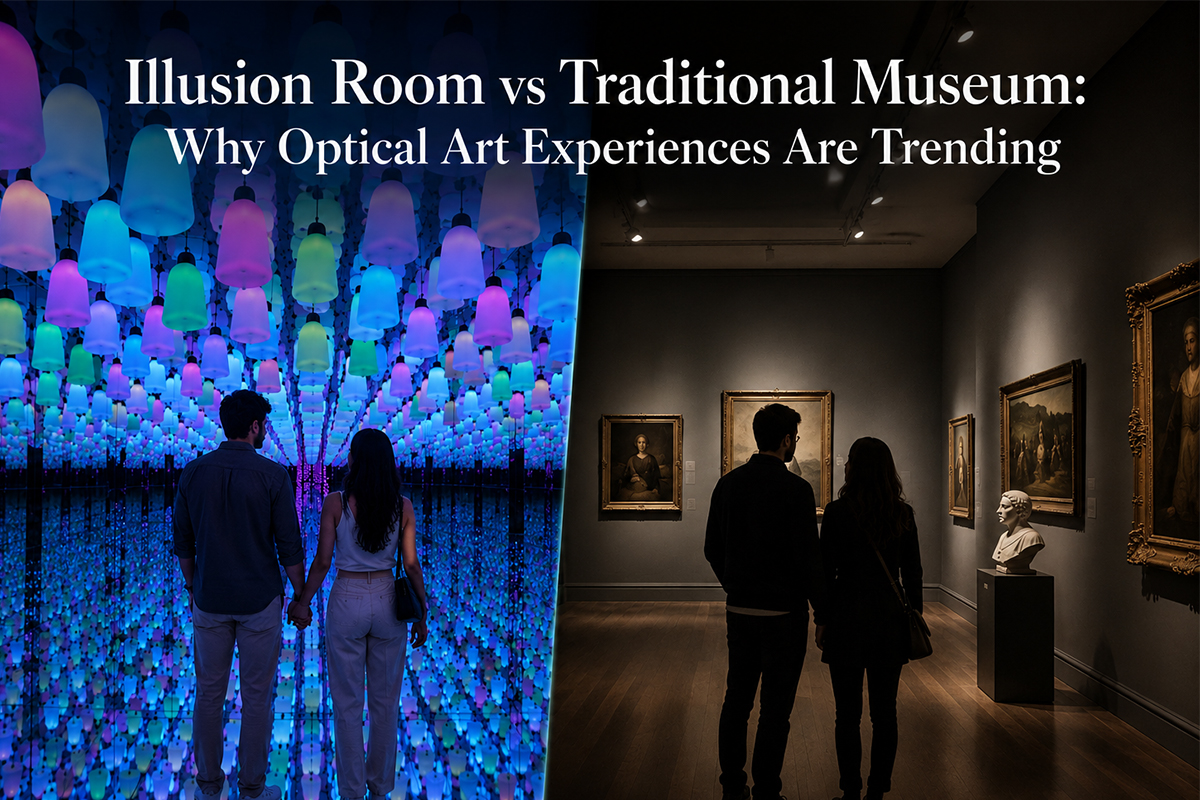
For generations, visiting a museum meant walking through galleries, observing paintings and sculptures, reading descriptions, and appreciating art from a distance. Traditional museums continue to play an important role in preserving history, culture, science, and artistic heritage.
But the way people experience art is changing.
Today, visitors increasingly want to do more than simply look at an artwork. They want to step into it, interact with it, photograph it, and become part of the experience. This shift has helped optical art, illusion rooms, immersive installations, and interactive exhibitions gain attention among families, young adults, couples, and content creators.
If you’ve been searching for an illusion room in Mumbai, an immersive art experience in Mumbai, or simply something different from a traditional museum visit, this new generation of attractions offers a completely different way to experience creativity.
So, how does an illusion room compare with a traditional museum? And why are optical art experiences becoming such an interesting option for modern-day outings?
Traditional Museum vs Illusion Room: What’s the Difference?
The biggest difference comes down to how visitors interact with the environment.
A traditional museum is generally designed around observation. Visitors move through galleries and view carefully preserved objects, artworks, artefacts, or historical collections.
An illusion room takes a more interactive approach. Instead of simply observing the artwork or environment, visitors become part of it.
Neither format is necessarily better than the other. They simply offer different ways of experiencing art and creativity.
Why Optical Art Experiences Are Becoming Popular
People increasingly look for experiences that combine entertainment, creativity, interaction, and shareable moments. Optical art fits naturally into this shift because it makes perception part of the experience.
Instead of simply asking, “What am I looking at?”, visitors begin asking: What is actually happening around me? Where does the room begin and end? Is that a reflection or a real pathway? Why does the space look different from this angle? How can I capture this moment in a photograph?
This combination of curiosity and interaction is one of the reasons optical art experiences can be particularly engaging for modern audiences.
What Is an Illusion Room?
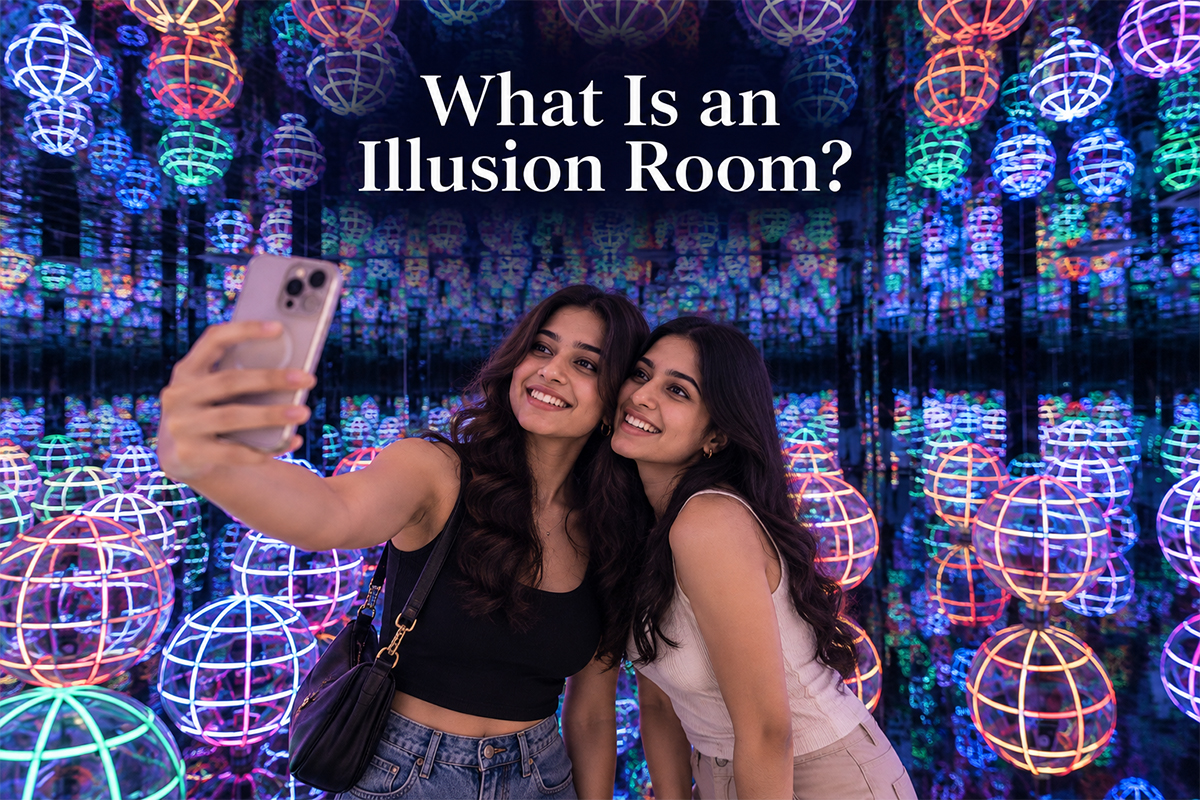
An illusion room is a specially designed environment that uses elements such as mirrors, lighting, perspective, repetition, spatial design, and visual effects to challenge how visitors perceive their surroundings.
Instead of presenting a single artwork on a wall, the entire environment becomes part of the experience.
Visitors may see reflections that appear endless, pathways that seem to continue beyond their actual boundaries, or spaces that create unusual visual effects when viewed from different positions.
That makes an illusion room in Mumbai particularly different from a conventional gallery visit. The visitor isn’t simply looking at an illusion, they are moving through it.
How Optical Illusions Turn Visitors Into Participants
One of the biggest strengths of optical art is participation.
In a traditional gallery, the artwork remains separate from the visitor. In an illusion-based environment, the visitor’s movement can become part of what makes the experience interesting.
Walk in one direction and the reflections may look one way. Change your position and the visual composition can appear completely different.
This encourages exploration rather than passive observation.
For families, it can create shared moments of discovery. For couples and friends, it can become a playful challenge. For content creators, it provides an environment where photographs can look dramatically different from ordinary indoor spaces.
Zingfinity at Zingverse: An Illusion Experience in Mumbai
At Zingverse, Zingfinity brings together mirrors, reflections, lighting, movement, and spatial illusions to create an interactive environment.
The experience is designed around perception. As visitors move through the space, reflections and visual elements create unexpected perspectives that make the environment feel larger, more complex, or different from what it initially appears to be.
Rather than functioning like a conventional museum gallery, Zingfinity encourages visitors to explore the environment itself.
For anyone looking for an illusion room in Mumbai or a unique indoor attraction, it offers a different way to spend time with friends, family, or a partner.
Illusion Room vs Traditional Museum: Which Experience Is Right for You?
Choose a Traditional Museum If You Enjoy History & Culture: Traditional museums are ideal for visitors who enjoy historical collections, paintings, sculptures, cultural artefacts, scientific exhibits, and educational displays.
Choose an Illusion Room If You Want Interaction: If your idea of a good outing involves movement, visual surprises, photography, and exploration, an illusion room may be more suitable.
Choose an Immersive Experience If You Want Both Visuals & Entertainment: Immersive entertainment sits somewhere between art, technology, and experience. It can transform an ordinary room into a visual environment that surrounds the visitor.
Why Immersive Art Feels Different From Traditional Art
Traditional art often asks the viewer to pause and observe. Immersive art asks the viewer to enter the environment.
That difference can change the emotional experience.
A large immersive projection can surround you with colour and movement. A mirror installation can challenge your sense of depth. A carefully designed tunnel can make an ordinary walk feel like a visual journey.
This is why searches for terms such as immersive art near me, immersive museum near me, and immersive art installations near me are increasingly relevant to people looking for experiential entertainment.
However, visitors should also understand that an immersive entertainment destination is not necessarily a conventional museum. The purpose, format, and experience can be very different.
Beyond the Mirror Maze: Exploring Zingverse
One reason Zingverse stands apart from a standalone illusion attraction is the variety of experiences available within the same destination.
Alongside Zingfinity, visitors can explore different immersive environments designed around sensory play, visual storytelling, and interactive exploration.
Zinglow – A Colourful Sensory Experience: Zinglow offers a vibrant environment designed for younger visitors. Its colourful and playful setting encourages curiosity, exploration, and sensory engagement.
Zingdom – A 360° Immersive Visual Experience: Zingdom creates a different type of experience by transforming the surrounding environment with large-scale digital visuals and immersive projections.
Kingdom of Kingdoms – An Immersive Walkthrough: Kingdom of Kingdoms introduces immersive tunnel experiences featuring dynamic lighting, visual transitions, depth effects, and cinematic walkthrough elements.
Why Optical Art Works So Well for Families
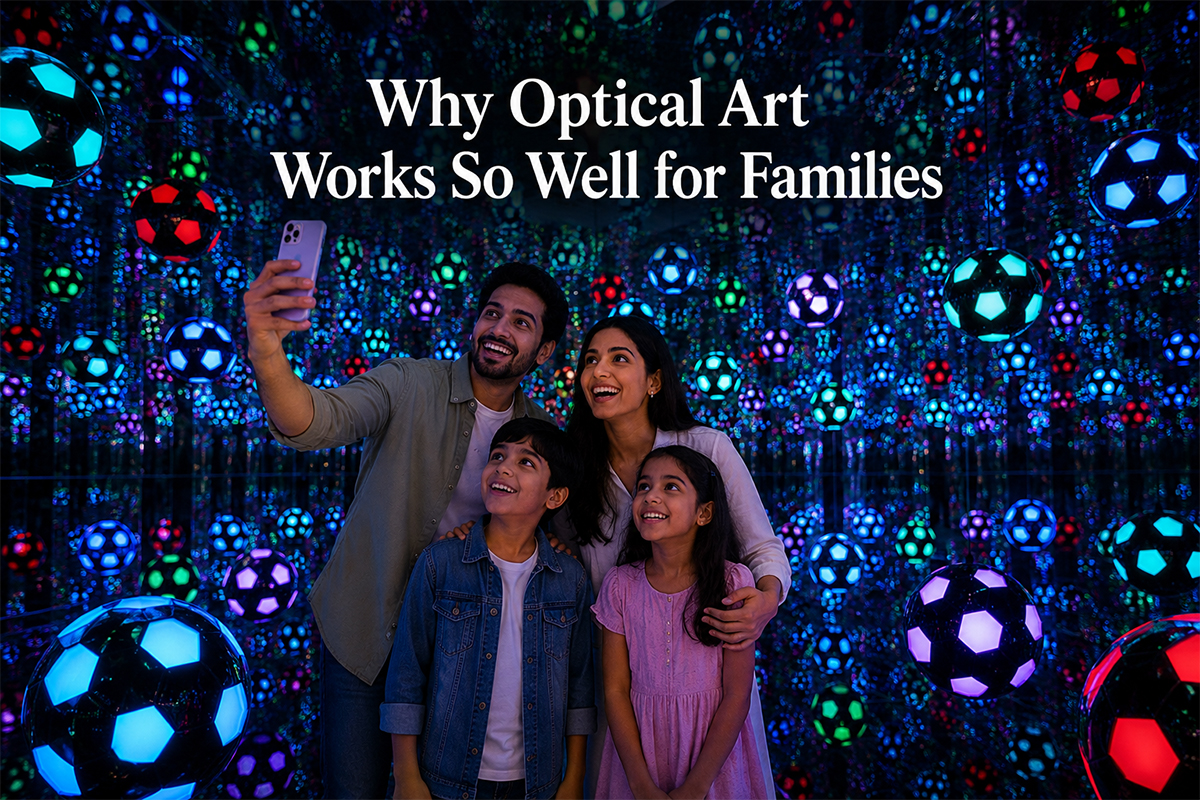
One challenge with family outings is finding an activity that different age groups can enjoy together.
A traditional museum may appeal strongly to adults or older children interested in history and culture, while younger children may find extended gallery visits difficult.
Optical and immersive experiences can provide a more active format.
Children can explore visual effects and unusual spaces. Teens can enjoy photography and interactive environments. Adults can appreciate the design, creativity, and technology behind the installations. Families can experience the attraction together rather than separating into different activities.
That makes immersive entertainment an interesting option when planning indoor activities in Mumbai for different age groups.
Why Optical Art Is Perfect for Photography
Another major difference between traditional museums and optical experiences is the way the environments interact with photography.
Mirrors create repetition. Lighting changes the mood. Perspective creates unusual compositions. Large immersive environments can create dramatic backgrounds without requiring elaborate photography equipment.
At Zingverse, photography and videos are welcome inside the experience zones, allowing visitors to capture their own moments while exploring.
This makes spaces such as Zingfinity and Zingdom particularly interesting for couples, families, friends, and content creators looking for unique visual experiences.
Is an Immersive Art Experience the Same as a Museum?
Not exactly.
An immersive art experience and a traditional museum can both provide opportunities to engage with creativity, but their formats are different.
A museum generally focuses on collections, preservation, education, history, and artistic or cultural context. An immersive attraction typically focuses more on interaction, visual storytelling, technology, perception, and entertainment.
For visitors searching for an immersive museum near me, it is worth checking what type of experience they actually want before choosing a destination.
If you want to study historical artefacts, a museum may be the better choice. If you want to walk through visual environments, explore optical illusions, and capture photographs, an immersive attraction may be more suitable.
Things to Do in Mumbai Beyond Traditional Sightseeing
Mumbai offers an enormous variety of activities, from historical landmarks and cultural institutions to shopping destinations, restaurants, entertainment centres, and indoor attractions.
If you’re searching for things to do in Mumbai, an optical or immersive experience can add something different to your itinerary.
Instead of simply visiting a location and taking a few photographs, you can choose an activity that gives you something to actively experience.
For families, couples, groups, and young adults, this can make an ordinary weekend outing feel more memorable.
Why Zingverse Is More Than a Single Attraction
Zingverse is designed as a larger indoor entertainment destination rather than a single optical installation.
Its different immersive worlds allow visitors to experience different combinations of colour, light, sound, reflection, movement, and visual storytelling.
That variety means visitors don’t have to choose between an illusion room, a sensory experience, or an immersive visual environment. They can explore different experiences during the same outing.
Located at Metro Junction Mall, Kalyan East, Zingverse also gives visitors the convenience of combining their experience with other activities available within the mall.
Final Thoughts: The Future of Experiential Art
Traditional museums are not disappearing. They continue to play an important role in education, culture, history, and art appreciation.
But alongside them, a new category of experiential entertainment is developing.
Illusion rooms, optical art installations, immersive projections, interactive environments, and sensory experiences are changing how people think about an outing.
Instead of simply looking at art, visitors can step into it. Instead of observing an illusion, they can become part of it.
For people searching for an illusion room in Mumbai, an immersive art experience, or a unique alternative to traditional sightseeing, Zingverse offers an opportunity to experience this new approach firsthand.
At Zingfinity, reflections and perception become the centre of the experience. At Zingdom, visual storytelling surrounds the visitor. And across Zingverse, different immersive worlds create an outing built around exploration and interaction.
If you’re looking for something beyond the traditional museum experience, perhaps the next way to appreciate art is not just to look at it, but to step inside it.
Frequently Asked Questions
1. What is an illusion room?
An illusion room is an interactive environment that uses mirrors, lighting, perspective, spatial design, and visual effects to create unusual perceptions and optical illusions.
2. Is there an illusion room in Mumbai?
Yes. Zingfinity at Zingverse in Metro Junction Mall, Kalyan East, offers a mirror and motion-based illusion experience for families, couples, friends, and groups.
3. What is the difference between an illusion room and a traditional museum?
A traditional museum is generally focused on viewing collections, artefacts, and artworks, while an illusion room is designed around interaction, perception, movement, and visual experiences.
4. What is an immersive art experience?
An immersive art experience places visitors inside a visual or sensory environment using elements such as projection, lighting, sound, spatial design, and interactive installations.
5. Is Zingverse a museum?
Zingverse is an immersive indoor entertainment destination rather than a traditional museum. It combines interactive attractions, illusion-based experiences, sensory environments, and immersive visual installations.
6. Is photography allowed at Zingverse?
Yes. Photography and videos are welcome inside the experience zones, allowing visitors to capture moments throughout their visit.
7. Where is Zingverse located?
Zingverse is located on the 1st Floor of Metro Junction Mall, Kalyan East, within the Mumbai Metropolitan Region.
8. What are some unique things to do in Mumbai?
Unique things to do in Mumbai include exploring immersive attractions, illusion rooms, interactive art experiences, cultural spaces, entertainment destinations, and other indoor experiences. Zingverse offers several immersive experiences under one roof.